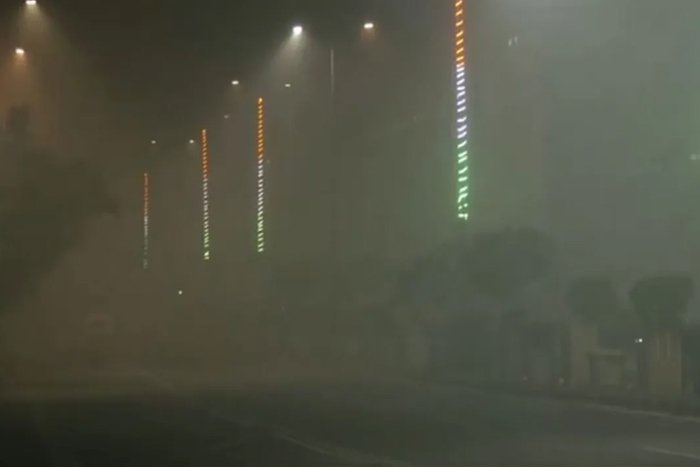
Delhi continued to battle toxic air on Monday, a day after Diwali, with several areas recording an Air Quality Index (AQI) above the 400 mark as firecracker emissions added to the national capital’s already deteriorating air quality. The city’s average AQI stood at 376 in the ‘very poor’ category at 7 am, as per the Central Pollution Control Board (CPCB)’s Sameer app.
Several parts across the capital recorded ‘severe’ air quality on Monday. Sonia Vihar reported the highest AQI at 449, followed by Burari Crossing at 445 and Vivek Vihar at 441, according to the HT Pollution Dashboard. Jahangirpuri recorded an AQI of 439, while Delhi University’s North Campus stood at 437 and Rohini at 435. Other areas in the ‘severe’ category included DTU (431), Bawana (424), Chandni Chowk and Patparganj (418 each), Mundka (413), NIH Narela and Punjabi Bagh (408 each), Commonwealth Sports Complex (404) and ITO (404).
The AQI at ITO had earlier touched 406 at 4:20 am on Monday, according to the CPCB data cited by news agency ANI. The city’s average AQI was 376 on Sunday, in the ‘very poor’ category, up from 369 a day earlier.
‘Severe’ pollution in Delhi-NCR
Across the National Capital Region (NCR), Ghaziabad recorded an average AQI of 369, also in the ‘very poor’ category, while New Tehsil-Loni registered the highest reading at 459. Noida’s average AQI stood at 338, with Sector 62 recording 440. Greater Noida reported a relatively better average AQI of 297 in the ‘poor’ category.
Gurugram and Faridabad recorded average AQI levels of 312 and 329, respectively, both in the ‘very poor’ category. However, Faridabad’s Sector 11 recorded an AQI of 410, placing it in the ‘severe’ category, as per HT Pollution Dashboard.
Delhi’s AQI on Diwali
According to the HT Pollution Dashboard, Delhi’s air quality deteriorated sharply by 8pm on Diwali night as firecrackers began bursting across the city. The average PM2.5 concentration across 39 monitoring stations that also reported data last Diwali rose from 190 µg/m³ in the 15-minute period beginning at 7.45pm to 259 µg/m³ from 8pm, according to an analysis of the Central Pollution Control Board’s (CPCB) 15-minute records by HT. The 8pm average was more than four times India’s 24-hour PM2.5 standard of 60 µg/m³.
At 5.30pm, Delhi’s air quality was already in the ‘very poor’ category, even before firecrackers were burst in large numbers. The overall AQI stood at 376, under the ‘very poor’ category. The Capital also witnessed reduced visibility.
Of the 59 monitoring stations, 12 recorded air quality in the ‘severe’ category, while 22 reported ‘very poor’ air quality. The Air Quality Early Warning System (EWS) for Delhi had forecast that air quality was likely to deteriorate to the ‘severe’ category from November 9 and remain there for the next few days.
By 7pm, the city’s AQI stood at 371, in the ‘very poor’ category. Of the 59 monitoring stations, 19 were in the ‘severe’ category, seven in the ‘poor’ category and the remaining 33 in the ‘very poor’ category. According to a PTI report, several people took to social media to report smelling smog and firecracker smoke in the air, while others flagged reduced visibility.
At 9pm, Delhi’s AQI, according to official data, stood at 370, while the HT Pollution Dashboard reported it at 389. Both readings were in the ‘very poor’ category. The difference in the figures is because the official AQI calculation includes 20 more monitoring stations than the HT Pollution Dashboard’s comparison of stations that reported data last Diwali. Most of these additional stations recorded cleaner air, pulling the official average down by 19 points.
By 10pm, the city’s AQI stood at 371, under the ‘very poor’ category, according to the CPCB. Of the 59 monitoring stations, 20 were in the ‘severe’ category, 33 reported ‘very poor’ air quality and six were in the ‘poor’ category. Sonia Vihar recorded the highest AQI at 463, placing it in the ‘severe’ category.
The CPCB classifies an AQI of 0-50 as ‘good’, 51-100 as ‘satisfactory’, 101-200 as ‘moderate’, 201-300 as ‘poor’, 301-400 as ‘very poor’ and 401-500 as ‘severe’.
Article source: hindustantimes.com