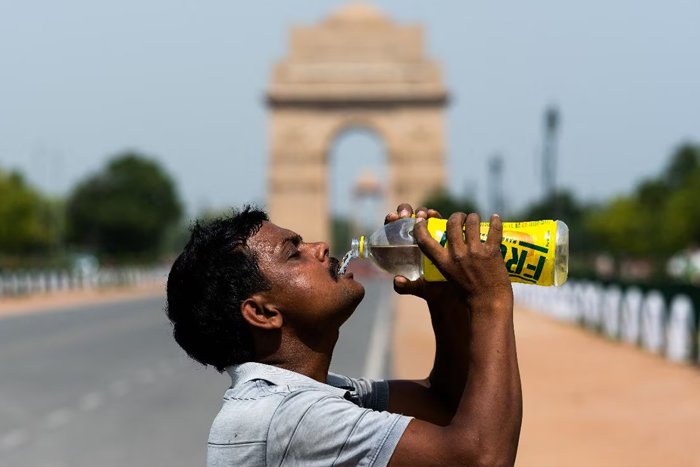
Among several stations, Ridge recorded the maximum temperature at 46.5°C, making it the hottest location in Delhi during the day. Safdarjung and Palam registered 45.1°C, while Lodhi Road recorded 45.2°C and Ayanagar touched 45.5°C.
Delhi-NCR remained in the grip of an intense heat wave on May 19 with temperatures soaring beyond 45 degrees Celsius across all major weather stations in the capital, according to observations released by the India Meteorological Department (IMD) at 5:30 pm. This extreme spike in temperature made it the hottest day in May recorded in the capital in the last two years.
Earlier, the capital registered its hottest day on May 18 (Monday), with the temperature nearing 44 degrees Celsius in several parts. As per the Safdarjung station, Delhi’s primary and official weather centre, the maximum temperature stood at 43.4 degrees Celsius, making it the hottest day in May. However, the temperature on Tuesday shot up to 45.1°C, setting a new record.
Among several stations, Ridge recorded the maximum temperature at 46.5°C, making it the hottest location in Delhi during the day. Safdarjung and Palam registered 45.1°C, while Lodhi Road recorded 45.2°C, and Ayanagar touched 45.5°C.
The upward temperature trend was consistent with early morning observations on Tuesday. By 11 am, both Safdarjung and Palam weather observatories in Delhi had already recorded 41°C, with temperatures climbing up to 44°C across the city by 12:45 pm.
IMD data showed that temperatures were significantly above normal across the region. Lodhi Road recorded the sharpest departure from normal at 6.2°C above average, followed by Ridge at 5°C above normal and Safdarjung at 4.7°C higher than usual. Such deviations fall within the category of severe heat wave conditions.
The data also indicated that the maximum temperature rose by 1.1°C to 1.9°C across different monitoring centres within 24 hours, reflecting a rapid escalation in daytime heating.
Nighttime conditions provided little relief. Minimum temperatures remained elevated between 27°C and 28.2°C across Delhi. Safdarjung recorded a minimum of 28.2°C, while Palam and Ridge both logged 28.1°C. Weather experts say persistently high nighttime temperatures are particularly dangerous because they prevent the human body from cooling down after prolonged daytime heat exposure.
No rainfall was recorded anywhere in Delhi between 8:30 am and 5:30 pm, and the 24-hour cumulative rainfall at all stations stood at zero. The absence of rain and cloud cover, combined with dry winds and intense solar heating.
GRAP 1 INVOKED IN DELHI
Along with the rising temperature, increasing pollution can also cause severe headaches for people.
On Tuesday, the Commission for Air Quality Management (CAQM) on Tuesday, May 19, invoked Stage 1 of the Graded Response Action Plan (GRAP) across Delhi-NCR as the national capital region’s air quality index (AQI) entered the “poor” category.
“The AQI of Delhi has shown an increasing trend and recorded as 208 (‘Poor’ Category) today, i.e. on 19.05.2026. Further, the forecast by IMD/ IITM indicates AQI to remain in ‘Poor’ category in the coming days,” the CAQM said in a formal release.
Article source: indiatoday.in