When the US and Israel combined to bombard Iran this year, there was a simple assumption: a short, decisive, one-sided conflict. That assumption died a slow death as the war dragged on for over a month, strangling the global economy. Iran did not crumble under pressure, and emerged more unpredictable, if not more dangerous. The conflict provided a sobering lesson – modern wars don’t follow old, conventional scripts. For India, the timing of the lessons is hard to ignore as its Operation Sindoor against Pakistan completes a year. The warnings from the Iran war will be difficult to ignore.
Now, you may ask why? Iran, in some ways, is like Pakistan. In his book Tinderbox: The Past and Future of Pakistan, former Union Minister MJ Akbar calls Pakistan a “toxic jelly state” – always unstable. Unlike butter, which melts or solidifies, jelly wobbles and stays in place. Thus, with India having a “state sponsor of terrorism” country as its neighbour and a radical army chief like Asim Munir at its helm, the next conflict is not a question of why, but when.
INDIA’S PAKISTAN TEMPLATE
Shortly after the three-day hostilities in May last year, Prime Minister Narendra Modi laid the template – a “new normal” where India will “strike precisely and decisively” without tolerating any nuclear blackmail.
A US intel report presented to the Senate in March this year specifically noted that conditions exist for terrorist actors to continue to create “catalysts for crises”. It also did not rule out a potential nuclear conflict in the future. Another report by a US think-tank, the Council on Foreign Relations (CFR), said there was a “moderate likelihood” of an armed conflict between India and Pakistan due to heightened terrorist activity.
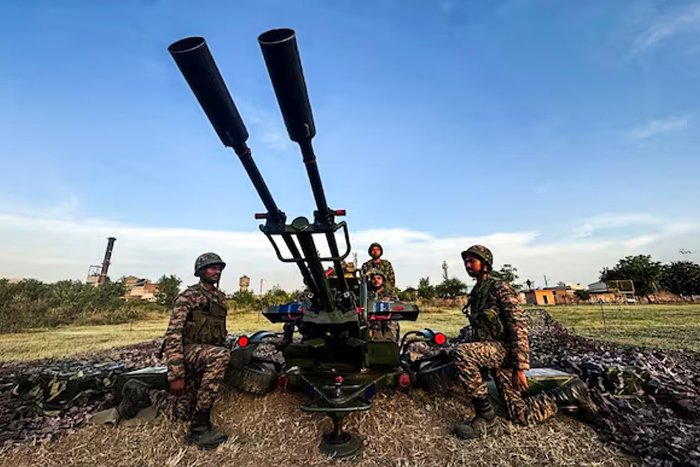
Thus, against this backdrop, it becomes essential for Indian military planners to be prepared for a fast, saturated with drones and missiles, multi-domain warfare like the Iran war has shown us. A country nearly half the size of India inflicting massive damage on a technologically superior US and Israel has given strategic and military thinkers across the world food for thought.
The conflict, which engulfed the whole of the Middle East, has thrown a buzzword – asymmetric warfare. It is basically a combination of guerrilla tactics and surprise attacks using drones.
COLD START 2.0
The Iran conflict has also shown the advantages of non-kinetic warfare, where damage can be inflicted on a country without crossing its airspace. Iran used this to full effect, sending swarms of cheap Shahed drones to strike US military assets and energy infrastructure across the Gulf.
A glimpse of it was seen during Operation Sindoor as well. On May 7, under the darkest hours of the night, India launched its most daring operation in Pakistan in reprisal for the Pahalgam terror attack. India engaged in what is termed as a “stand-off” conflict – using long-range weapons to flatten nine terror camps deep inside Pakistani territory.
Pakistan responded by sending hundreds of Turkish-made Asisguard Songar drones in waves, targeting around 35 military sites from Punjab to Jammu. However, most of them were intercepted by India’s integrated air defence network, with the Russian S-400 Trimuf doing the heavy lifting. A ballistic missile, probably the Fateh, fired towards Delhi was also neutralised over Haryana.
The very next day, a rampage by IAF jets and drones saw 11 PAF air bases being hit. Pakistan had no option but to retreat and dial India for a ceasefire. May 10, 2025, will be etched in Pakistan’s memory similar to December 16, 1971 – the day 93,000 Pakistani soldiers surrendered in the Bangladesh Liberation War.
According to defence expert Sandeep Unnithan, Sindoor showed the contours of a future conventional conflict with Pakistan.
“It is what I would call Cold Start 2.0, where the Indian military, for the first time in its history, can go from ‘silent to violent’ in minutes,” Unnithan told IndiaToday.in.
The origins of the Cold Start strategy can be traced back to 2002. India’s Operation Parakram, launched after the 2001 Parliament attack, exposed gaps in India’s ability to rapidly mobilise troops. In fact, it took three weeks for Indian troops to mobilise and reach their positions. It allowed Pakistan to counter-mobilise its troops and invited global intervention. The shock factor was gone.
Article source: indiatoday.in