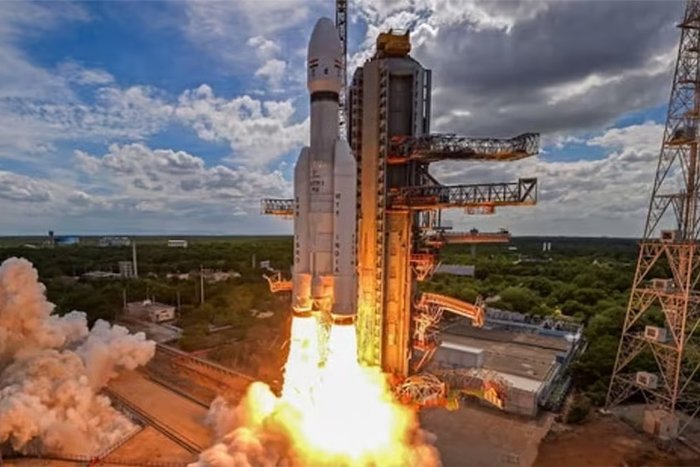
ISRO suffered a major setback on Monday after ISRO’s Polar Satellite Launch Vehicle (PSLV-C62) encountered a critical anomaly during the rocket’s third stage, leaving the status of all 16 satellites on board uncertain.
The 44.4-metre-tall PSLV lifted off at 10.18 am from the Satish Dhawan Space Centre in Sriharikota, carrying an Earth observation satellite – EOS-N1 (Anvesha) – and 15 co-passenger satellites from India and overseas. The mission was intended to place them into a 512-kilometre Sun-Synchronous Orbit after a 17-minute flight.
The launch began smoothly. ISRO’s live broadcast showed the rocket performing normally through its first and second stages, and the third stage ignited as planned. But soon after that announcement, officials noticed that something was wrong.
Disturbance during third stage
ISRO chairman V Narayanan said the trouble began near the end of the rocket’s third stage, when strap-on motors were providing thrust.
“The PSLV is a four-stage vehicle with two solid stages and two liquid stages. The performance of the vehicle up to the end of the third stage was expected. Close to the end of the third stage we are seeing more disturbance in the vehicle and subsequently, there was a deviation observed in the flight path,” Narayanan said at the Mission Control Centre.
That deviation meant the rocket could no longer follow its precise trajectory needed to inject the satellites into their intended orbit.
About 30 minutes after liftoff, ISRO confirmed on X that the mission had “encountered an anomaly” during the end of the PS3 (third-stage) burn and that a detailed analysis was under way.
“The PSLV-C62 mission encountered an anomaly during end of the PS3 stage. A detailed analysis has been initiated,” ISRO wrote.
What happened to the 16 satellites
ISRO has not yet confirmed whether EOS-N1 and the 15 other satellites were successfully deployed. Telemetry and tracking data from ground stations are still being analysed to determine what happened to the spacecraft after the rocket went off course.
“Today, we attempted the PSLV-C62/EOS-N1 mission… the mission could not proceed in the expected flight path. That is the information right now available,” Narayanan said.
He added that ISRO would share more details once data from all tracking stations had been studied.
A worrying repeat
The anomaly is particularly troubling because the previous PSLV mission in May 2025 also ran into problems in the third stage. That makes Monday’s incident a second consecutive setback for the workhorse rocket.
The PSLV has long been regarded as ISRO’s “workhorse”, having flown missions to the Moon and Mars and launched satellites for dozens of countries. Out of more than 60 flights, only a handful have failed – but back-to-back setbacks now threaten that reputation.
For now, ISRO says it is focused on analysing the flight data to establish exactly what went wrong – and what became of the 16 satellites that were supposed to begin their journey in orbit.
Article source: hindustantimes.com