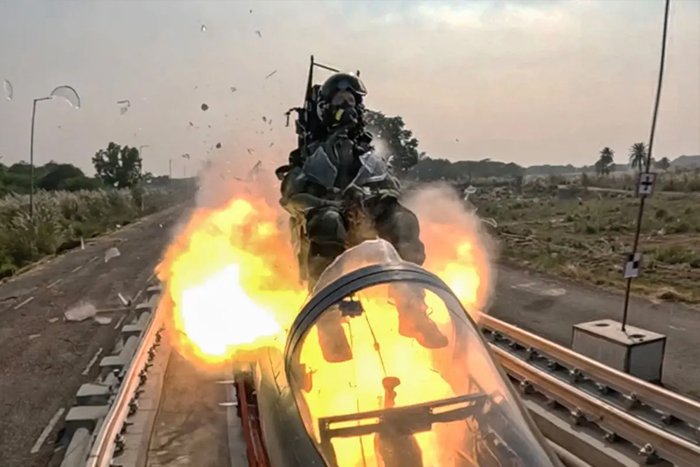
The Defence Research and Development Organisation (DRDO) has carried out a successful high-speed rocket-sled test of fighter aircraft escape system, defence ministry said on Tuesday.
In a major boost to indigenous fighter jet safety tech, the test demonstrated that the pilot-ejection mechanism functions accurately and safely under extreme conditions.
The test was conducted at a precisely controlled speed of 800 km/h at the Rail Track Rocket Sled (RTRS) facility of the Terminal Ballistics Research Laboratory (TBRL) in Chandigarh, the ministry said in a social media post accompanying a video.
The clip shows the staged test, where the system successfully propelled a dummy pilot clear of the cockpit, illustrating how the mechanism ensures safe ejection when a fighter jet encounters a life-threatening situation.
Watch the video here:
According to the defence ministry, the trial validated three critical components of a modern escape system — canopy severance, ejection sequencing, and complete aircrew recovery.
Defence minister Rajnath Singh congratulated DRDO, the Indian Air Force, ADA, HAL, and industry partners on the achievement, calling it a significant milestone that strengthens India’s indigenous defence capabilities and advances its broader push toward self-reliance, the ministry added.
The latest testing milestone comes amid a broader push to highlight India’s growing self-reliance in defence technologies.
Earlier in August, DRDO chairman Samir V Kamat said that Operation Sindoor, conducted in May, had demonstrated the effectiveness of indigenous military systems during a complex, multi-domain mission along the western borders.
At the convocation of the Defence Institute of Advanced Technology (DIAT), Kamat said the operation reflected not only the bravery of Indian soldiers but also the strength of the technological framework that supported them. “I can say with pride that Operation Sindoor’s success was powered by homegrown systems such as Akash short- and medium-range surface-to-air missiles, BrahMos supersonic cruise missiles, the D4 anti-drone system, airborne early warning and control platforms, the Akashteer air defence control system, and advanced C4I systems,” he said.
Kamat added that institutes like DIAT were central to developing these indigenous capabilities, underscoring the momentum behind India’s defence-modernisation drive.
Article source: hindustantimes.com