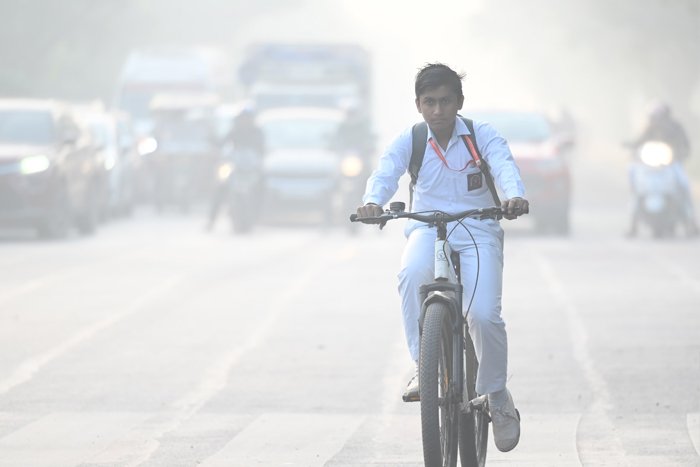
As Delhi’s air quality deteriorated further during the day, breaching the 400 mark and slipping into the ‘Severe+’ category, the Commission for Air Quality Management (CAQM), the Centre’s anti-pollution panel, imposed GRAP 4 restrictions in the national capital and its adjoining areas from tonight. This came just hours after the CAQM had enforced GRAP 3 earlier in the day, when air quality levels were hovering above 300.
The Air Quality Index (AQI) stood at 448 at 7 pm on Saturday, according to data from the Central Pollution Control Board (CPCB).
GRAP is a set of emergency measures aimed at tackling severe air pollution.
Under GRAP Stage IV, the commission has rolled out stricter emergency measures in addition to the curbs already in force under Stages I, II and III. All construction and demolition activities, including earthwork, excavation and structural work, have been halted, along with the operation of stone crushers, brick kilns, hot mix plants and mining units. Industrial units using coal, furnace oil or other unapproved fuels have also been ordered to shut down.
The entry of diesel-powered medium and heavy goods vehicles into Delhi has been banned, except for those carrying essential commodities. The use of BS-III petrol and BS-IV diesel four-wheelers has also been prohibited. In addition, non-essential inter-state diesel buses that are not BS-VI compliant, electric or CNG have been barred.
The use of diesel generator sets has been restricted to emergency and essential services only, while open burning of any kind, including waste and biomass, has been banned. Any activity that may lead to increased dust generation or emissions is also not permitted.
Are schools closed in Delhi?
According to the circular dated December 13, the Delhi Directorate of Education directed all schools to conduct classes for students up to Class IX and XI in a hybrid mode in light of the deteriorating air quality in the national capital.
According to the circular dated December 13, government, government-aided, and unaided recognised private schools under the Directorate of Education, NDMC, MCD, and the Delhi Cantonment Board have been instructed to offer both physical and online classes wherever feasible until further orders.
50% WFH in offices
In an official order, the government also directed that all administrative secretaries and heads of departments shall attend office regularly, with no more than 50 per cent staff strength physically present.
“The remaining 50 per cent staff shall work from home, provided that the Administrative Secretaries and Heads of Departments can call officers/officials to the office, as required to ensure uninterrupted delivery of essential and emergency public services,” the order read.
Likewise, the order stipulated that all private offices operating within Delhi shall function with no more than 50 per cent staff physically attending the workplace.
“The remaining staff shall mandatorily work from home,” it added.
The order also urged all private entities to implement staggered working hours where feasible.
Furthermore, private offices have been instructed to ensure strict compliance with work-from-home norms and minimise vehicular movement related to office commutes.
Article source: livemint.com