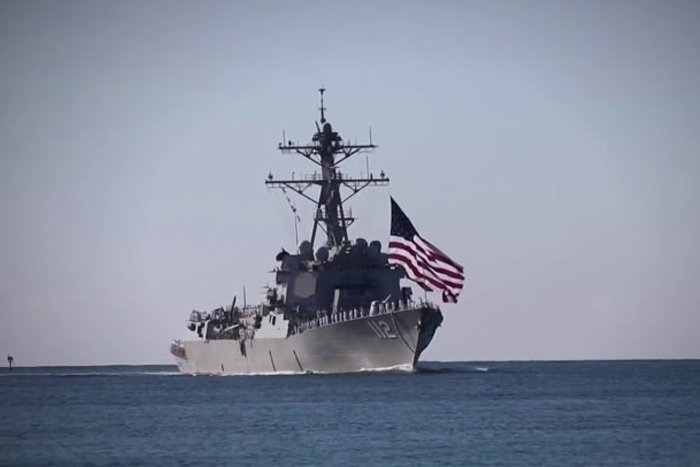
The US military said the blockade, set to begin on Monday, would be enforced ‘impartially against vessels of all nations’ accessing Iranian ports and coastal areas, including facilities along the Arabian Gulf and the Gulf of Oman.
US President Donald Trump on Sunday announced that the American Navy would begin blockading maritime access to Iranian ports through the strategically vital Strait of Hormuz, sharply escalating tensions after high-stakes talks with Iran collapsed without a breakthrough.
The US Central Command (Centcom) said the blockade would take effect at 10 am ET (7.30 pm India Time) on Monday, targeting all vessels entering or exiting Iranian ports. In a statement, Centcom added that the move would be “enforced impartially against vessels of all nations” using Iranian ports and coastal areas, including those along the Arabian Gulf and Gulf of Oman.
However, the US military stopped short of a full shutdown of the Strait. It said freedom of navigation would be maintained for vessels transiting to and from non-Iranian ports, signalling a calibrated approach aimed at isolating Iran without completely disrupting global shipping lanes.
TRUMP ISSUES STARK WARNING
In a series of posts on social media, Trump adopted an aggressive tone, warning that any vessel paying what he described as “illegal tolls” to Iran would face consequences.
“I have also instructed our Navy to seek and interdict every vessel in International Waters that has paid a toll to Iran. No one who pays an illegal toll will have safe passage on the high seas,” he wrote, adding that Iranian forces targeting US or commercial vessels would be met with overwhelming retaliation. “Any Iranian who fires at us, or at peaceful vessels, will be BLOWN TO HELL!”
Trump also said US forces would begin clearing naval mines allegedly deployed by Iran in the Strait, one of the world’s most critical oil chokepoints, through which roughly 20 per cent of global energy supplies pass.
IRAN RESPONDS WITH WARNING OF ESCALATION
Iran reacted swiftly, with the Islamic Revolutionary Guard Corps warning that any foreign military presence near the Strait would be treated as a violation of the fragile ceasefire.
Iranian Parliamentary Speaker Mohammad Baqer Qalibaf dismissed Trump’s threats, saying Tehran would not be pressured into concessions. “If you fight, we will fight, and if you come forward with logic, we will deal with logic,” he said.
Ghalibaf also mocked the potential economic fallout of the US move, warning it could drive up global fuel prices, including in the United States. He shared an image of current petrol prices near the White House, warning Americans that they ‘will miss them’ soon.
TALKS COLLAPSE AFTER MARATHON NEGOTIATIONS
The blockade announcement follows the failure of 21-hour negotiations in Islamabad, which was the first direct talks between Washington and Tehran in more than a decade and the highest-level engagement since the 1979 Islamic Revolution.
Iran’s Foreign Minister Abbas Araqchi accused the US of derailing a near-agreement, citing “maximalism, shifting goalposts, and blockade tactics” when the two sides were close to finalising an “Islamabad MoU”.
US Vice President JD Vance, who led the American delegation, acknowledged the breakdown but struck a defiant note: “The bad news is that we have not reached an agreement, and I think that’s bad news for Iran much more than it’s bad news for the United States.”
Key sticking points included Iran’s refusal to halt uranium enrichment, dismantle nuclear facilities, and end support for regional groups such as Hamas, Hezbollah and the Houthis. Disagreements over reopening the Strait and broader security guarantees also proved insurmountable.
OIL PRICES SURGE, MARKETS RATTLED
Markets reacted sharply to the developments, with oil prices surging above USD 100 per barrel amid fears of supply disruptions. Brent crude rose significantly from pre-war levels of around USD 70 per barrel, underscoring the geopolitical risk premium.
The US dollar strengthened as investors sought safe-haven assets, while global markets entered a seventh week of volatility driven by the ongoing conflict and uncertainty around energy flows.
Trump himself acknowledged the domestic political risks, saying high oil and petrol prices could persist through the upcoming midterm elections.
CEASEFIRE HANGS IN BALANCE
The escalation casts doubt over the fragile two-week ceasefire announced earlier, with no clarity on what will follow its expiry. While both sides signalled openness to further negotiations, rhetoric on both sides has hardened.
Despite tensions, some maritime activity has resumed. Shipping data showed that a handful of oil tankers transited the Strait over the weekend, the first since the ceasefire, highlighting the delicate balance between conflict and commerce.
Diplomatic efforts continue, with Pakistan offering to mediate further talks and global powers, including Russia and the European Union, urging restraint. However, with military posturing intensifying and core disagreements unresolved, the risk of a broader confrontation in the Gulf remains high.
Article source: indiatoday.in