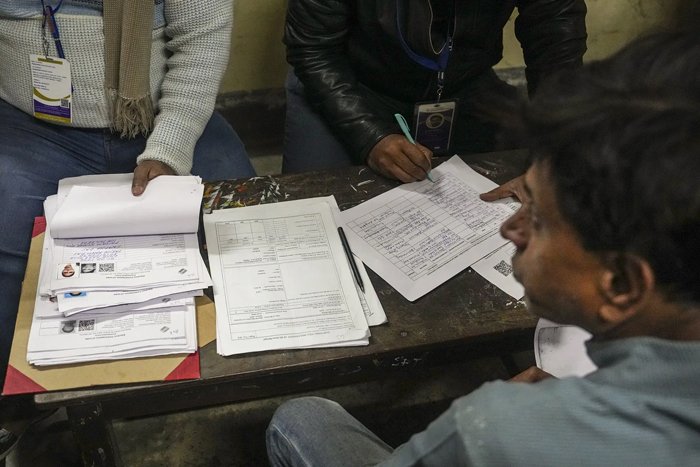
BLOs will verify existing voter details, help eligible residents enrol and identify electors who have died, permanently shifted or are registered at more than one place. The exercise also begins in Karnataka, Meghalaya, Maharashtra and Jharkhand on June 30
More than 13,000 Booth Level Officers will begin knocking on doors across Delhi on Tuesday, launching a month-long verification of nearly 1.45 crore voter records.
The house-to-house exercise marks the start of the Special Intensive Revision of the electoral rolls in the national capital. BLOs will verify existing voter details, help eligible residents enrol and identify electors who have died, permanently shifted or are registered at more than one place.
The exercise also begins in Karnataka, Meghalaya, Maharashtra and Jharkhand on June 30.
Delhi currently has 1,45,10,298 registered voters, including 67,98,142 women and 1,024 third-gender electors.
Briefing reporters on Monday ahead of the rollout, Delhi’s Chief Electoral Officer Alok Kumar laid out the schedule and mechanics of the exercise.
The verification phase will run until July 29, after which a draft electoral roll will be released on August 5. A window for filing claims and objections will then remain open until September 4, with the process of reviewing and resolving these claims continuing through October 3. The final, updated voter list is scheduled to be published on October 10.
How the verification will work
Officers will visit each household twice over, once to hand over duplicate enumeration forms to registered voters and help them complete the paperwork, and again to collect the filled forms, with at least three attempts planned per household. If a voter cannot be reached in person, the form will be passed to another adult in the household or left behind if the home is locked. Each voter will keep one copy bearing an acknowledgement of submission, while the BLO retains the other.
More than 13,000 Booth Level Officers have been mobilised for the drive, tasked with confirming the details of existing voters, identifying first-time entrants to the rolls, and correcting any inaccuracies. Delhi currently has just over 1.45 crore registered voters, including close to 68 lakh women and 1,024 individuals registered under the third gender category.
For residents who have moved to Delhi from elsewhere after the last such revision in 2002, Kumar advised checking the Election Commission’s online portal to retrieve relevant historical voter details, including constituency information and serial numbers from earlier rolls, which can help establish their record during the current process.
A nationwide exercise marked by controversy
This phase of SIR in Delhi comes against the backdrop of a broader, year-long national exercise that has already led to the removal of nearly six crore names from voter lists across 19 states and union territories, according to PTI. The drive, which began in Bihar last June ahead of that state’s assembly elections, triggered sharp pushback from opposition parties who alleged the process was being used to selectively disenfranchise voters lacking specific documentation. In Bihar alone, the exercise had pared down the electoral roll by close to 65 lakh names.
The Supreme Court weighed in on the matter in March, unanimously affirming the Election Commission’s constitutional authority to carry out the revision exercise.
Documentation and process
Ahead of the Delhi rollout, election officials, sub-divisional magistrates, and party representatives underwent a day of training covering the technical and procedural aspects of the 2026 exercise, conducted with support from Election Commission specialists.
Voters generally do not need to submit any supporting documents during the initial enumeration stage — the form itself is sufficient unless officials specifically request further verification. In such cases, acceptable proof includes documents such as passports, birth certificates, educational certificates, caste certificates, government-issued identity cards predating July 1987, and land or housing allotment certificates, among others.
Officials have also clarified that the entire process, including form submission and verification, is free of cost, and eligibility will ultimately be determined based on valid documentation, age, and residence criteria as per Commission guidelines.
Article source: businesstoday.in