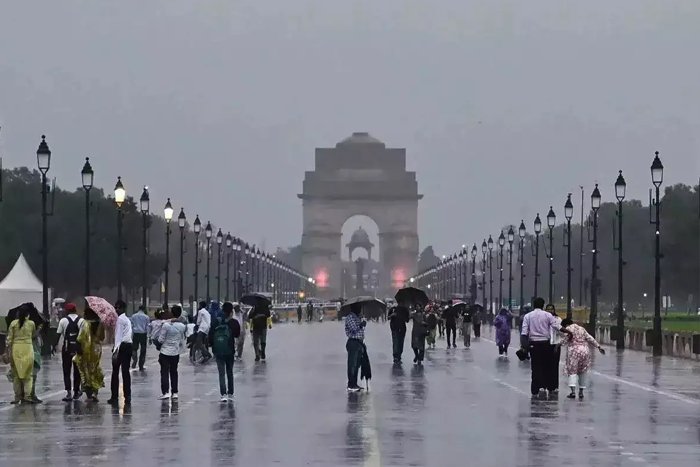
Mercury dipped to as low as 3.6°C in parts of Delhi on Monday as isolated coldwave conditions were recorded across the capital, even as air quality deteriorated to the “poor” category, snapping a rare two-day streak of “moderate” air in January. The capital logged its coldest Republic Day in five years on Monday, with temperatures last falling this low in 2021 at 2.1°C.
Officials said the sharp dip in minimum temperature was caused by clear skies and sustained icy northwesterly winds over the weekend. However, wind speeds weakened during the day on Monday due to the approach of a western disturbance, which is expected to raise temperatures and bring light rain to the city on Tuesday.
Delhi’s 24-hour average air quality index stood at 241 at 4pm on Monday, compared with 153 at the same time on Sunday, according to Central Pollution Control Board data. Sunday’s reading was also Delhi’s lowest AQI for January in four years.
The India Meteorological Department has issued a yellow alert for Delhi-NCR for Tuesday, forecasting one to two spells of light rain in the city, accompanied by gusty winds of up to 40 km per hour. Officials said the weather system is likely to help keep air quality in check. Fresh snowfall is expected in the higher reaches.
“An intense western disturbance is likely to cause light to moderate rainfall and snowfall at many places over the western Himalayan region on January 27 and 28, with isolated heavy rain or snow and hailstorms expected on January 27. Further, light to moderate rainfall is likely at some places over the adjoining plains of northwest India along with isolated thunderstorms or hailstorms with wind speeds reaching 40-50 km/hr and gusting to 60 km/hr on January 26,” the IMD said in its national bulletin on Monday.
Safdarjung, considered representative of Delhi’s weather, recorded a minimum temperature of 4.2°C, which was four degrees below normal for this time of the year. The station had logged a minimum of 6.6°C on Sunday and 7.6°C on Saturday.
Elsewhere, Ayanagar in southwest Delhi recorded a minimum of 3.6°C, which was 5.4°C below normal, while North Delhi’s Ridge recorded 5.3°C, also five degrees below the seasonal average.
IMD defines a cold wave when the minimum temperature falls below 10°C and is at least 4.5°C below normal, or when the actual minimum temperature drops to 4°C or lower. At least two weather stations in Delhi met this criterion on Monday.
Similar cold conditions prevailed across the National Capital Region, with isolated pockets recording ground frost. The IMD said Gurugram recorded a minimum temperature of 4.2°C, which was one degree below normal. Minimum temperatures for Noida and Ghaziabad were unavailable for the day, it added.
Delhi’s maximum temperature on Monday stood at 23.2°C, which was a degree above normal. On Sunday, the maximum had settled at 18.2°C, two degrees below normal.
According to the IMD forecast, Delhi’s minimum temperature is expected to hover between 8°C and 10°C on Tuesday, while the maximum is likely to range between 18°C and 20°C.
“When a western disturbance approaches, it causes a change in wind direction to warmer easterly winds. Overcast skies also lead to a rise in minimum temperature and a dip in maximum temperature,” said Mahesh Palawat, vice president at Skymet. He added that with fresh snowfall expected through this western disturbance, minimum temperatures across the plains are likely to dip again from January 29. “If northwesterly winds had persisted, the minimum currently would have dipped even further. This fresh western disturbance will snap that streak,” he said.
Navdeep Dahiya, an amateur weatherman, said pockets in the suburbs of Gurugram and the outskirts of the NCR recorded ground frost during the early hours. Residents in south Delhi’s Sainik Farms also reported frost. “A rich layer of frost had accumulated on car windows in the morning. Our local private weather station in the area recorded a minimum of 2.3°C,” said Sahil Pershad, a resident of Sainik Farms.
Meanwhile, forecasts by the Centre’s Air Quality Early Warning System for Delhi indicated that air quality is likely to improve again on Tuesday following rainfall.
“Delhi’s AQI is likely to be in the ‘moderate’ category from January 27 to 28. It is likely to be in the ‘poor’ category on January 29,” the EWS said in its daily bulletin.
The CPCB classifies air quality as “moderate” when AQI ranges between 101 and 200, “poor” between 201 and 300, and “very poor” between 301 and 400. AQI values above 400 are categorised as “severe”.
Article source: hindustantimes.com