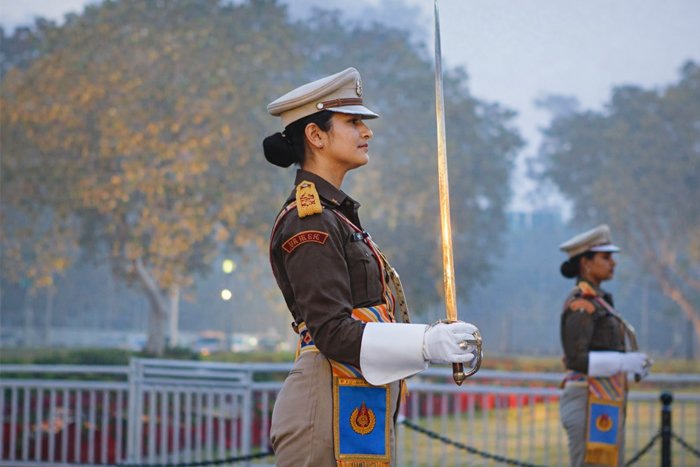
Assistant commandant Simran Bala, a 26-year-old officer of the Central Reserve Police Force (CRPF), will lead an all-male marching contingent at the Republic Day parade on January 26, officials said, marking a first for the country’s largest central armed police force and a milestone in the gradual reshaping of leadership norms within uniformed services.
Bala, who hails from Nowshera in Jammu and Kashmir’s Rajouri district, was selected after a rigorous, multi-stage evaluation that included weeks of rehearsals, full-dress drills and command assessments along Kartavya Path. She will command a contingent of more than 140 male personnel drawn from operational units of the CRPF.
Speaking to HT, Bala described the opportunity as both an honour and a responsibility. “I feel truly honoured to get the opportunity to lead the CRPF contingent at this national-level ceremony in the Republic of India,” she said. Preparations, she added, began over a month ago. “We had rigorous drill practices with specific concentration on each individual. We focused on team cohesion, precision and on how commands are taken and executed. I hope all of this reflects on the final day.”
The role is among the most visible ceremonial responsibilities in India’s security establishment and has traditionally been assigned to senior male officers. While women have previously led women-only or mixed contingents, commanding a fully male formation remains rare across uniformed forces.
Bala joined the CRPF after clearing the Union Public Service Commission’s Central Armed Police Forces (Assistant Commandants) examination on her first attempt, securing a rank within the top 100. She completed her training at the CRPF Academy in Gurugram, where instructors rated her among the strongest performers of her batch, citing discipline, leadership qualities and communication skills.
Her first operational posting was with a Bastariya battalion in Chhattisgarh, deployed in areas affected by Left Wing Extremism. Officers who worked with her during field tenure described her as composed and decisive — attributes that later translated into her performance during ceremonial training.
Raised in a border district that has witnessed frequent cross-border firing, Bala said her upbringing played a role in shaping her aspirations. “Growing up, I was surrounded by men and women in uniform. That atmosphere always inspired me,” she said. She is the first woman from her district to be commissioned as a Group A officer in the CRPF.
On the evolving role of women within the force, Bala said her experience reinforced the view that opportunities are increasingly being decided by merit rather than gender. “CRPF has always been a pioneer in promoting gender equality. Over the years, the force has moved towards a more inclusive system where responsibilities and opportunities are assigned purely on merit,” she said, pointing to the raising of women battalions and the induction of women into operational roles.
She also had a message for young women from Jammu and Kashmir. “My journey shows perseverance and faith in hard work. I always believed in education and effort,” Bala said. “To all the girls in the Valley, I would say: believe in yourself, dream big and work hard. Today, opportunities are based on merit, and as a nation we need capable and committed women as part of 50% of the workforce in every field.”
Her family, she said, has reacted with pride and excitement. “My parents are very happy and proud. Everyone is eagerly waiting for January 26,” she said.
Officials said Bala’s appointment reflects a broader institutional shift within the central armed police forces, where women officers are increasingly being entrusted with frontline and leadership responsibilities rather than confined to support roles.
Preparations for the 77th Republic Day parade are underway, with contingents from the armed forces and central armed police forces undergoing strict evaluation protocols. Bala’s march past the saluting base on January 26 is expected to draw attention not only for ceremonial precision, but also for what it signals about changing command structures within India’s security forces.
For residents of Rajouri and nearby border areas, her presence at the head of a marching column on the country’s biggest ceremonial platform has become a point of pride — and a visible reminder that pathways from the periphery to positions of national prominence are widening.
Article source: hindustantimes.com