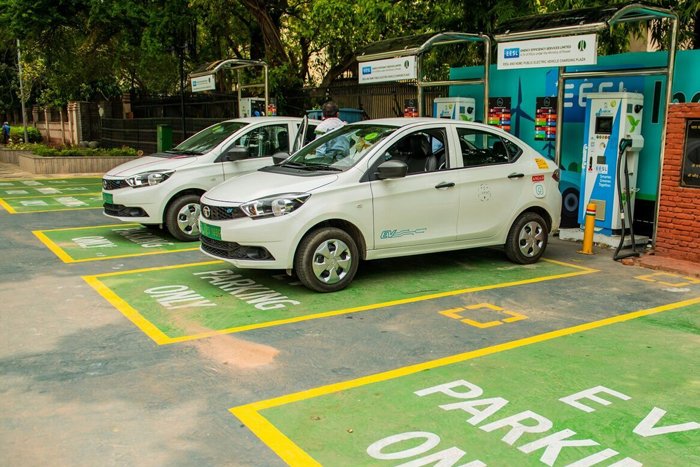
With only 8,998 public electric vehicle (EV) charging points against the required figure of 36,177, Delhi currently has a shortfall of 75.2%, or nearly 27,179 charging points, according to the Capital’s state action plan on pollution submitted to the Commission for Air Quality Management (CAQM). The plan, released by CAQM on Sunday, stated that the Delhi government aims to nearly double the existing infrastructure, targeting 16,070 public charging points by the end of 2026.
Despite the gap, Delhi’s charging network remains significantly ahead of neighbouring towns in the National Capital Region (NCR).
Action plans submitted by NCR cities show that Gurugram and Faridabad currently have no public EV charging points, against requirements of 20 and 26 respectively. Noida has 69 points compared with a requirement of 150, while Greater Noida has only three, short of its target by 13 points. Ghaziabad has 126 public charging points against a requirement of 450, leaving a deficit of 324.
To be sure, CAQM officials clarified that these figures refer only to charging points installed on public land and under government purview, and exclude private charging infrastructure located within institutions or private premises that may not be universally accessible.
“These numbers do not capture charging points installed by private entities on private land,” a CAQM official said.
Across Delhi and other NCR cities, the action plans collectively target the addition of more than 7,300 public charging points by the end of this year. In Delhi alone, nearly 7,000 new charging points are planned in 2026, with the bulk to be installed by the transport department, according to the Delhi government’s submission to CAQM.
Smaller numbers are proposed at major transit hubs, including six charging points each at the Anand Vihar and New Ashok Nagar Regional Rapid Transit System (RRTS) stations, and 66 points at Delhi Metro stations.
The plan also addresses battery-swapping infrastructure. Delhi currently has 948 battery-swapping stations against a requirement of 1,606. The government has set a target of increasing this number to 1,268 by the end of 2026.
Experts, however, cautioned that expanding public charging infrastructure alone will not be sufficient to support large-scale EV adoption.
“Unlike petrol or diesel vehicles, electric vehicles can be charged where they are parked. Global data shows that 80–90% of EV charging happens at these locations,” said Amit Bhatt, managing director (India) at the International Council on Clean Transportation.
He added that many group housing societies in India do not permit residents to install charging infrastructure. “Countries like Norway have a ‘Right to Charge’. India needs similar legislation to allow charging in RWAs and housing societies,” Bhatt said.
A CAQM official said all NCR states and cities have now submitted their pollution mitigation action plans, each outlining self-defined targets.
Article source: hindustantimes.com