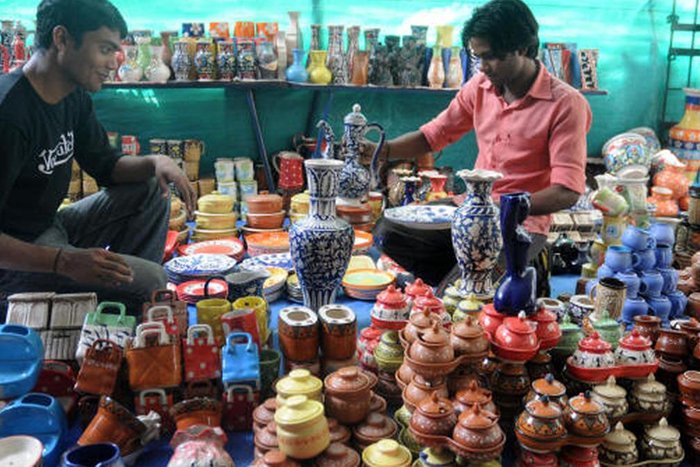
The war in the Middle East has brought manufacturing in India’s ceramic hub Khurja to a standstill, with 90% of the 300 units shutting shops temporarily. The election in West Bengal has added to the crisis. With workers scrambling to survive, Khurja is a microcosm of the distress in India’s manufacturing hubs.
“Earlier, whatever I earned, I would somehow save and send Rs 5,000 home to Bihar every month. That amount has now come down to Rs 3,000,” says a worker at a ceramic factory in Uttar Pradesh’s Khurja. “On the one hand, the cost of refilling cooking gas has jumped from Rs 90 per kg to Rs 400. On the other hand, the prices of groceries and vegetables have surged. On top of that, the kilns no longer burn the same. The LPG situation has weakened the fire,” he adds.
The diminished heat of these kilns is now worrying the factory owners too. A ceramic factory owner, speaking to India Today Digital, says supplies of 422-kg LPG Hippo cylinders have been delayed by a week. “We’re now relying on costlier PNG. The godown is full of finished cups, mugs and vases, but there’s been a sharp dip in sales. And a majority of my workers, who are from West Bengal, have gone to vote in the Assembly elections,” adds the ceramic factory owner, who employs 15 people. Before the LPG crisis hit due to the war in the Middle East, his factory would produce 3,000 ceramic cups a day.
Just 85 km south-east of the national capital, New Delhi, stress has gripped both workers and factory owners in Khurja, aka India’s ceramic city. Since the onset of the US and Israel’s war on Iran, the supplies of LPG, which fires the kilns, have tightened. The other fuel, PNG, supplied by Adani Total Gas Limited, comes with its own set of challenges. Costs of raw materials, linked to petrochemicals, have risen, and demand has weakened. And the West Bengal Assembly elections have triggered a labour crunch, adding to the crisis in the ceramic city.
From the chai cups in our homes to the lassi kulhars sold at food carts, dinner sets, coffee mugs, garden pots and chic terracotta wall hangings, all kinds of ceramic products are made across the 300 units in Khurja, located in Uttar Pradesh’s Bulandshahr district. The shiny insulators on the electric poles are also produced in the MSMEs of Khurja. On e-commerce and quick-commerce platforms, most crockery you see likely comes from Khurja.
But the combination of demand and supply shocks has hit business hard. And 90% of the manufacturing units in the cluster now face a temporary shutdown for the next 20 days, until the workers return from West Bengal. “Even if the workers return, there’s no guarantee the other factors will improve. We can only hope things get better,” the factory owner, who runs his facility at Taina Gaospur on the southwestern outskirts of Khurja, tells India Today Digital on condition of anonymity.
While diesel has been allowed as an alternative fuel to ease the situation, Mohammad Naved Ansari, the owner of India R Ceramics, says “the bigger worry is what lies ahead if the choking in the Strait of Hormuz continues.”
The Middle East war-induced LPG crunch, rising power and raw material costs, the West Bengal polls, and weak demand have not only pushed the industry into distress, but also taken a toll on the businesses of ceramic factory owners and the lives and wellbeing of the workers who keep it running with their blood and sweat.
While Khurja’s situation and challenges are specific to its ceramic industrial cluster, they seemingly reflect the pressures and strains that other manufacturing centres in India might already be facing or could soon face.
While most products made in Khurja are not essentials but discretionary goods — typically in demand when consumers have disposable income — the town could, in a way, be a microcosm of the stress visible across industrial clusters in India, from the diamond and gold jewellery manufacturing units of Mumbai’s Zaveri Bazaar to the electronics hubs on Delhi’s eastern outskirts in Ghaziabad and Noida, and the cycle industry in Punjab’s Ludhiana.
Both factory owners and migrant workers in Khurja are under strain, but the latter are more vulnerable and have been hit harder.
KHURJA WORKERS HIT BY DOUBLE BLOW OF LABOUR CRUNCH AND LPG SHORTAGE
With many of Khurja’s ceramic workers — most of them from West Bengal — having returned to their villages to vote, several factories have either scaled down operations or shut temporarily. This has left the remaining workers from Bihar and Uttar Pradesh, who stayed behind, with little to no work. The LPG crunch has only added to their hardship.
“The workers who once earned Rs 500-600 a day are now left with zero wages. Many of them are highly specialised in ceramic work, but with kilns running below capacity or not at all, their skills are lying unused. Shifting to other sectors isn’t easy either. Their expertise does not readily translate into alternative jobs,” Shalabh Gupta, the owner of Srinivas Earthenwares, tells India Today Digital.
Even for those still employed, the pressure has mounted. Household expenses have surged. “The LPG cylinder refill cost has jumped from around Rs 900 to nearly Rs 2,500 (on the black market), while the cost of rations, fruits, vegetables and other daily essentials continues to rise. And I’ve four family members to look after here in Khurja and the extended family back home,” says a worker employed at a factory in Khurja’s Munda Khera Road.
Article source: indiatoday.in