Terming the non-compliance “serious”, the CAQM has directed the DPCC and other SPCBs to identify officers responsible for failures in implementation of GRAP measures and initiate appropriate proceedings against them.
The Commission for Air Quality Management (CAQM) has flagged “serious deficiencies” in the implementation of anti-pollution measures as per the Graded Response Action Plan’s (GRAP’s) Stage-III and Stage-IV norms, by the Delhi Pollution Control Committee (DPCC) and other state pollution control boards (SPCBs).
In its review, the CAQM noted shortfalls ranging from 7% to as high as 99.6% across key mandated actions, including inspections of construction and demolition sites, mechanical road sweeping, and deployment of mechanical road sweeping machines. In Delhi, while inspection of large construction sites showed an average shortfall of 87% during both Stage-III and Stage-IV of GRAP, it was around 70% in case of road sweeping, it said in a statement.
The review also highlighted high pendency of public complaints related to air pollution, with 47% of complaints remaining unresolved in Delhi during Stage-III and 68% during Stage-IV. The commission said such lapses reflect weak enforcement and grievance redressal mechanisms.
Terming the non-compliance “serious”, the CAQM has directed the DPCC and other SPCBs to identify officers responsible for failures in implementation of GRAP measures and initiate appropriate proceedings against them.
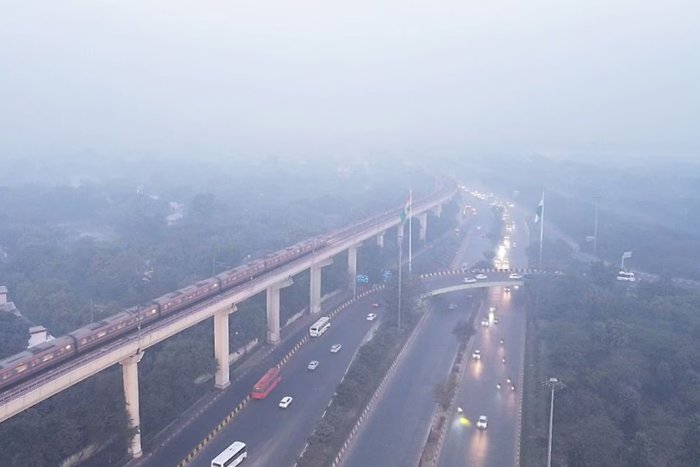
On Monday, Delhi’s air quality remained in the ‘severe’ category for the second day in a row, with an Air Quality Index (AQI) of 410, official data showed. The AQI was recorded at 440 on Sunday.
Gurgaon’s air quality stayed ‘very poor’, dropping from 378 on Sunday to 379 on Monday. In Noida, meanwhile, the air quality on Monday was ‘severe’ with an AQI of 412, showing a slight improvement from Sunday’s 430.
The maximum temperature in the Capital on Monday was recorded at 26.7 degree Celsius, around seven degrees above the season’s normal, while the minimum stood near normal at 7.7 degrees. Rising temperatures can be attributed to western disturbance due to cloudy conditions. The IMD has said that another intense western disturbance is likely to affect Northwest India from Wednesday night.
Maximum temperatures are likely to remain well above normal over the next four days, the weather department also stated. Very light rain or drizzle, accompanied by strong surface winds of 20-30 kmph is expected on Friday, while shallow to moderate fog is expected during morning hours over the next several days.
The Indian Institute of Tropical Meteorology (IITM) said the ventilation index for Delhi is likely to remain well below the favourable threshold of 6,000 m²/s over the coming days.
According to the IITM, Delhi’s air quality is likely to remain in the ‘very poor’ category till Thursday, with an outlook of ‘very poor’ to ‘poor’ air quality over the next six days.
Article source: indianexpress.com